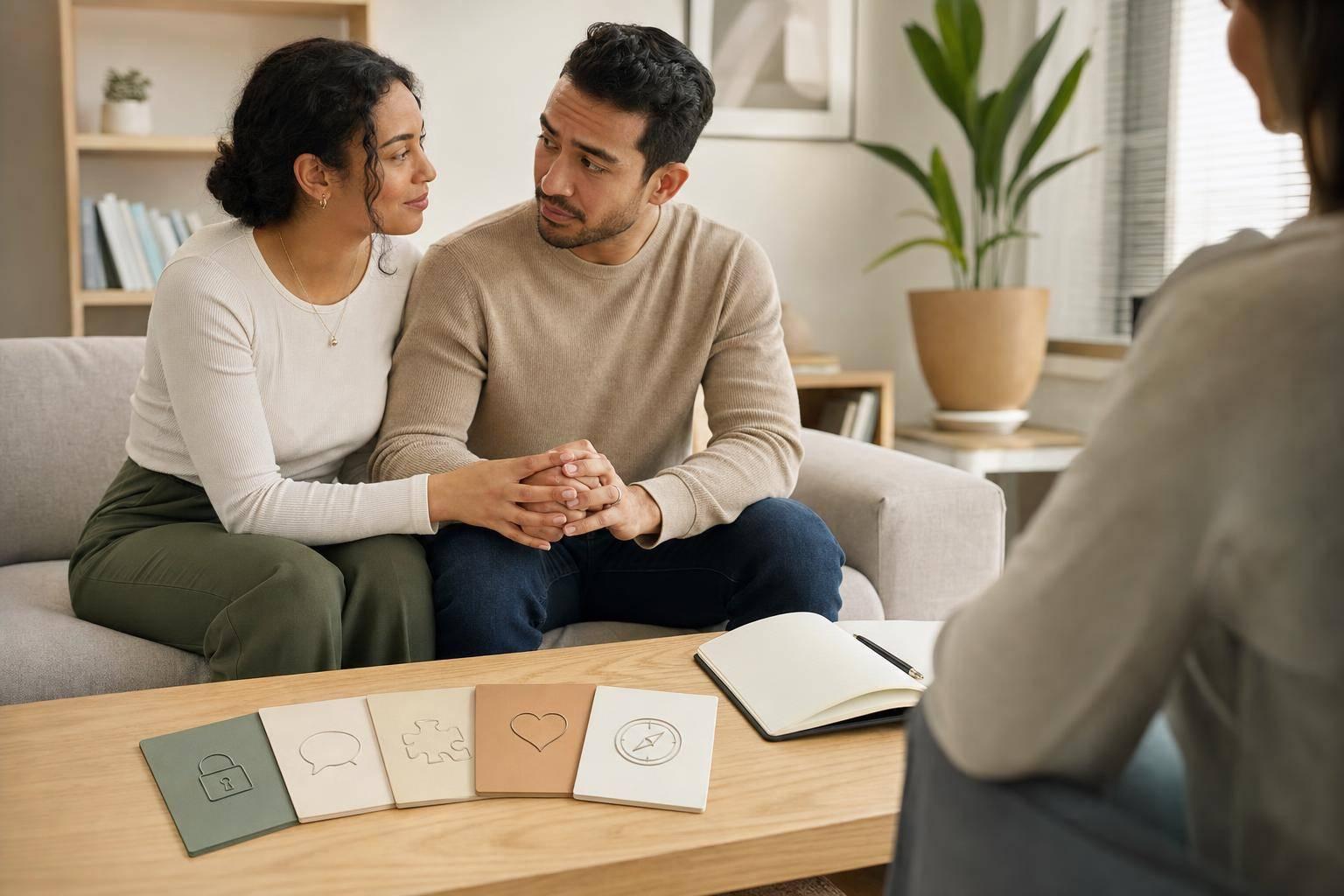
Before booking a first couples counseling session, ask two kinds of questions: a few honest ones between you and your partner about readiness and goals, and a few practical ones to ask the therapist about approach, structure, and fees. Working through both sets first helps you walk into the room with clearer expectations, not just hope.
This is a decision-stage question, different from wondering what happens at your first couples counseling session once it's booked. If you're still deciding whether to go at all, or which questions matter most before you call, this is the one to read.
Should we wait longer, or has too much time already passed?
Neither. A common worry is that couples wait years before getting help and that by the time they show up, it's too late. The actual research doesn't support that fear. A 2021 peer-reviewed study of 270 couples found an average interval of 2.68 years between the onset of relationship problems and starting couples therapy, with most couples entering therapy well within that window, not the six-year figure that circulates informally online (Doherty et al., 2021). The researchers noted little reason for pessimism about couples who wait: most problems that bring people to therapy are still workable when they finally come in. If you're asking "did we wait too long," the honest answer is probably no.
What should we ask ourselves before the first session?
A short, honest check-in between the two of you, separately and together, clarifies what you're actually hoping for.
- What changed recently, or what's been building for a while? A specific recent event and a long-simmering pattern call for different conversations with a therapist.
- What do I want to be different in three months? Vague hopes ("things to feel better") are fine as a starting point, but naming one concrete change helps a therapist know where to begin.
- Am I willing to look at my own part in this, not just my partner's? Couples therapy works best when both people are reflecting, not just one person hoping the other changes.
- Do we both want the same thing from therapy? You don't have to. One partner might be hoping to stay together and rebuild trust; the other might be unsure and want clarity either way. Being honest about that difference, rather than hiding it, is part of what a first session is for.
If you want a deeper look at how to talk through friction points before you even get to a therapist's office, conflict resolution skills for engaged couples and common communication barriers and how to fix them are useful starting points.
What questions should we ask a couples therapist before booking?
A short conversation or consultation call before your first full session is a reasonable thing to ask for, and a good therapist won't mind answering these directly.
- What's your training and approach? The two most research-supported approaches in the field are Emotionally Focused Therapy (EFT) and the Gottman Method; asking which a therapist uses, and why, tells you how they'll likely structure sessions.
- Is it always both of us together, or do you ever meet individually? Some therapists do occasional individual check-ins within a couples treatment plan; others keep every session joint.
- What's your confidentiality policy between partners? This matters more than it sounds. A "no secrets" policy, where anything shared individually can be brought into joint sessions, protects trust in the relationship; without it, one partner confiding something privately can quietly work against the shared goals of therapy (Inward Counseling).
- How do you handle it if we start arguing in session? You want a therapist who can slow a heated moment down, not just let it run.
- What are your fees, cancellation policy, and session length? Straightforward, but easy to forget to ask until the invoice shows up.
Our Couples Therapy Questions article covers more of what might come up once sessions are underway, including questions therapists often ask couples directly.
How long does couples therapy usually take?
Most couples therapy is shorter than people expect. Marriage and family therapists typically practice short-term treatment, averaging around 12 sessions, with close to two-thirds of cases completed within 20 sessions (Couples Academy, citing AAMFT data). That's not a guarantee of how long any one couple's work will take, since every relationship brings something different into the room, but it's a realistic range to picture rather than imagining an open-ended commitment.
When is couples therapy not the right starting point?
This is the question worth sitting with honestly before you book anything. Standard joint couples therapy is not considered appropriate when there's active abuse, specifically relationships involving severe or frequent physical violence or psychological aggression, a high degree of fear of retaliation from one partner, or an aggressive partner with an untreated substance use problem (Psych Central, summarizing clinical and ethics guidance). In situations like these, sitting two partners in the same room can put the person with less power at greater risk, and individual support is the safer and more appropriate starting point.
If you are in immediate physical danger, call or text 988 for the Suicide and Crisis Lifeline, which can also connect you to emergency support, or call 911. For domestic violence support specifically, the National Domestic Violence Hotline is available 24/7 by calling 1-800-799-7233 or texting START to 88788, confidentially and at no cost.
If any of this sounds like your relationship, it doesn't mean nothing can help. It means a different kind of support, often individual therapy focused on trauma or relationship concerns, is the safer next step before joint sessions are considered.
Common questions
Do we need to agree on everything before starting couples therapy?
No. You don't need matching goals or even the same level of certainty about the relationship's future. One partner can walk in hoping to repair things while the other is still deciding, and a therapist can work with that honestly as long as both people are upfront about where they stand.
What if my partner won't go to couples therapy?
Individual therapy is still a reasonable place to start on your own. Working through your part of the pattern, your communication habits, or your own stress around the relationship can be useful even if your partner isn't ready yet, and sometimes shifts the dynamic enough that they become open to joining later.
Is couples therapy the same as individual therapy with both people in the room?
Not quite. Couples therapy focuses on the relationship itself as the subject of the work, the patterns between two people, rather than treating either partner's individual history as the primary focus, though both inevitably come up.
How do we know if a therapist is a good fit after the first session?
You should both feel like the therapist is listening to each of you fairly, not siding with one partner, and that the pace and structure feel workable. If something feels off after a session or two, it's reasonable to say so directly or try a different therapist rather than assuming couples therapy itself isn't working.
Sources
- Initial Questions to Ask Couples Therapist - Inward Counseling
- Can Couples Therapy Work in Abusive Relationships? I Psych Central
- How long do people wait before seeking couples therapy? A research note - PubMed
- Marriage Counseling Statistics: Couples Therapy & Support | Couples Academy
Support close to home
BestLife Counseling Services offers in-person therapy in Cape May Court House and Rio Grande and telehealth across New Jersey. If this article sounds like what you or someone you love is carrying, request care and our team will help you find the right fit.
This article is general information, not medical advice or a diagnosis. If you are in crisis or thinking about harming yourself, call or text 988. If you are in immediate danger, call 911.