
Most engaged couples will argue. What matters is how they do it. This article boils marriage prep down to 7 skills: listen well, pick the right time, use “I” statements, repair after fights, set ground rules, solve problems together, and get counseling when you’re stuck.
I’d sum it up this way: conflict before marriage is normal, but repeat patterns like blame, shutdown, and poor timing can wear down trust. Research in the article points to a link between frequent conflict and a higher divorce risk, while premarital counseling can help couples spot the cycle under the fight and practice better habits before marriage starts.
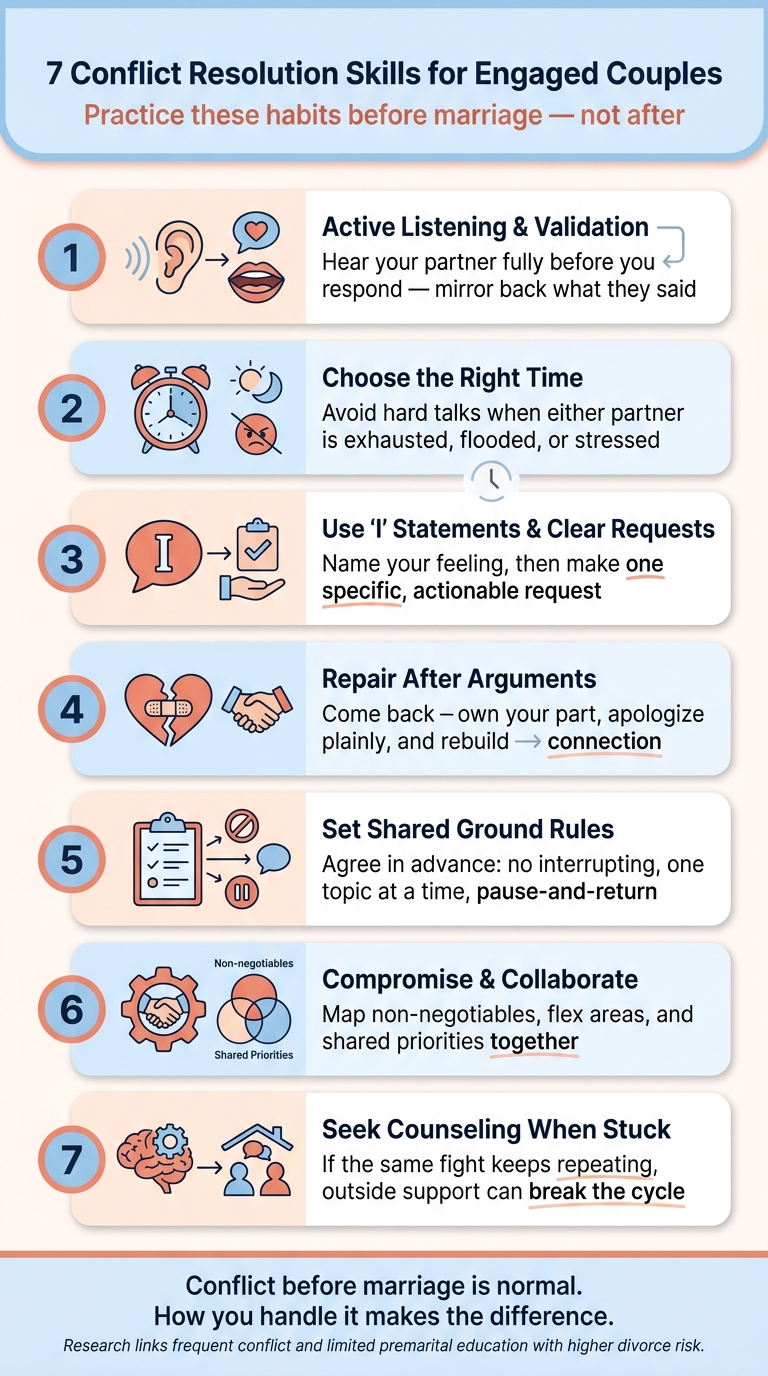
Here’s the full picture in one quick list:
- Active listening and validation: Hear your partner out before you answer.
- Right timing: Don’t start hard talks when either of you is flooded, exhausted, or late-night tired.
- Clear requests: Say what you feel and ask for one clear change.
- Repair after conflict: Come back, own your part, and apologize plainly.
- Shared rules: Agree on basics like no interrupting, one topic at a time, and pause-then-return.
- Compromise: Name non-negotiables, flex areas, and shared priorities.
- Counseling support: Get outside help if the same fight keeps repeating.
If I were getting ready for marriage, I’d treat these as daily habits, not emergency tools. That’s the point of the article: practice now, not later.
7 Conflict Resolution Skills for Engaged Couples
Even Healthy Couples Fight - the Difference Is How | Julie and John Gottman | TED
Why Conflict Skills Matter Before Marriage
Engagement can turn up the pressure. And when pressure goes up, conflict often gets messier. Couples may get defensive, blame each other, dodge the issue, or go quiet when talks get hard.
Research links frequent conflict and limited premarital education with a higher risk of divorce. So the goal isn't just having fewer arguments. It's having more awareness while those arguments are happening.
Premarital counseling tends to work best when couples first spot the pattern under the fight. The work shifts the focus from asking "What's wrong with my partner?" to asking "What cycle are we stuck in?" That small shift can change a lot. It helps couples see defensive habits and the cycle those habits create.
As couples build awareness of these patterns and their attachment styles, they can also grow compassion, emotional intimacy, and patience before marriage begins.
With that foundation, the first skill is active listening and validation.
1. Active Listening and Validation
Active listening is not just waiting for your turn to speak. It means trying to understand your partner before you answer. That matters a lot during an engagement, when talks about money, family, and wedding plans can all get tangled together. Before a hard talk goes off the rails, both people need to feel like they’re hearing each other clearly.
Feeling heard can stop a conversation from spiraling. One simple tool is mirroring: repeating back what your partner said before you respond. That shows you understood them instead of quietly building your rebuttal.
Validation is a different piece of the puzzle. It doesn’t mean you agree. It means you acknowledge that your partner’s feelings make sense from where they stand, even if you see the issue another way. That keeps the focus on the problem instead of turning the other person into the problem.
It also helps to give each partner set turns to speak. A little structure can lower the heat and make it easier to move from raw emotion to problem-solving. And like most relationship skills, active listening is learnable, but it takes steady practice to become a habit. Use it during calm moments too, so it doesn’t feel forced when the hard talks show up.
Once both partners feel heard, it gets easier to pick the right moment for the next hard conversation.
2. Choosing the Right Time for Hard Talks
Bad timing can turn a solvable problem into a full-blown argument. The point isn't to dodge hard talks. It's to have them when both people can think clearly. Good timing gives both of you a real shot at listening.
If your heart is racing, your chest feels tight, or you're sweating, pause the conversation. Then pick a new time to come back to it.
Pause, Reschedule, and Return
If voices start to rise, stop and set a new time. That can keep the talk from spiraling. Pausing doesn't mean you're avoiding the issue. It just means you're not forcing a bad conversation.
If you're not ready, be specific. Say: I can't talk about this now, but I'm free tomorrow afternoon. That keeps the issue on the table without pushing either person into a tense exchange.
One simple boundary can help a lot: don't start serious talks when either partner is exhausted. Skipping money or wedding talks late at night may sound small, but that habit can protect the quality of those conversations.
Once the timing is right, the next step is saying what you need clearly.
3. Using Clear Requests and "I" Statements
How you say something matters as much as what you say. If a talk starts with blame, it can turn into defensiveness fast. But an "I" statement shifts the focus from your partner's flaws to your own experience. "I feel overlooked when I'm talking and you're on your phone" gets the point across without throwing a punch. It opens the door to a real conversation.
Blame often sits on top of hurt, fear, or rejection. When you name the actual feeling, the tension tends to drop. That helps both people stay out of fight-or-flight mode.
It also helps to treat criticism as a sign that a need isn’t being met. Instead of staying stuck on what went wrong, move toward what you want to ask for. Say the feeling, then make the request: "I feel disconnected when you scroll during dinner. Can we keep phones away while we eat?" Keep it simple. One clear feeling and one clear request works best: "I feel overlooked when we're on our phones at dinner. Can we put them away for 30 minutes?"
A specific ask gives your partner something concrete to respond to. Vague frustration - "you're always so distant" - leaves them guessing. A direct request - "Can we put our phones away during dinner?" - gives them a clear next step.
Even clear requests won’t stop every argument, so the next skill is repairing after conflict.
4. Repairing After Arguments
Repair starts after the heat dies down. It's one of the clearest signs that a couple can deal with the strain of marriage in a healthy way. And it usually begins with one simple move: slow the conversation before it slips into blame and self-protection.
When conflict gets intense, take a short break. Then come back with a calmer tone. After both people have had the chance to say what they mean, repair helps shift the moment from hurt toward understanding. That means saying what stung, apologizing plainly, and owning your part in what happened. A little validation goes a long way too. It helps both partners feel heard and safer in the conversation.
Builds Trust Over Time
Steady repair builds trust over time and cuts down how long conflict hangs in the air. Couples who keep repairing, even when they don't do it perfectly, help each other feel respected and more connected.
Repair can turn conflict into a reset. And once couples know how to come back together after a fight, it becomes much easier to set clear ground rules that stop the same argument from spiraling again.
5. Setting Shared Ground Rules for Conflict
Ground rules are simple agreements that help hard conversations stay on track instead of spiraling. The best time to set them is before a conflict starts. Keep the list short and plain: no name-calling, no interrupting, one topic at a time, and a pause-and-return rule for moments when emotions get too high.
That kind of agreement makes honest conversation feel safer. It also cuts down on how often the same fight has to be cleaned up later. Use these rules alongside active listening and repair.
Prevents Escalation
Shared rules give arguments some guardrails. Instead of talking over each other or jumping from one issue to five others, both people know what the conversation is supposed to look like.
One helpful option is timed turn-taking during conflict, so each partner gets uninterrupted space to speak before the other responds. It sounds simple, but in the heat of the moment, that structure can keep things from going off the rails.
When emotions spike, take a 20-minute pause and agree on a set time to come back. That way, the issue doesn't get swept under the rug, but you're also not trying to solve it while both of you are upset.
Creates Actionable Next Steps
Rules are much easier to follow when they're written down. In tense moments, memory gets fuzzy. A clear plan on paper gives you something concrete to come back to.
Consider making a written conflict plan: a shared document that lays out how you both agree to handle conflict, so you're not trying to make the rules in the middle of an argument.
Helps Conflict Stay Manageable
Ground rules won't make conflict disappear. That's not the point. What they do is make disagreement easier to handle without turning every hard talk into a blowup.
When you practice them before marriage, they start to shape how you deal with tension as a team. Not just during bigger conflicts, but in the small day-to-day moments that test patience too.
6. Compromise and Collaborative Problem-Solving
Once the ground rules are clear, couples can stop circling the argument and start working on the actual decision. That shift matters. A lot of conflicts aren’t just about the surface issue. They’re tied to bigger concerns around wedding plans, money, family, or the routines you’ll build together.
Builds Mutual Understanding
A good place to start is simple: spell out each partner’s non-negotiables, flex areas, and shared priorities. That helps both people see what matters most, where there’s room to give, and where you’re already on the same side.
It also helps to notice your own stress reactions. If you tend to shut down, get sharp, or go into self-protection mode, naming that can change the tone of the conversation. Instead of turning the talk into blame, you make it about solving the problem together.
Creates Actionable Next Steps
When you reach an agreement, write it down and set the next check-in. A short shared note can go a long way. It gives you something clear to come back to when the same kind of decision shows up again, whether that’s about money, chores, holidays, or future goals.
Be specific:
- Who’s handling what
- When it needs to happen
- When you’ll revisit the plan
That way, the agreement isn’t just talked about and forgotten. It stays usable in day-to-day life.
Supports Long-Term Relationship Stability
Compromises tend to hold up better when they line up with shared values and get reviewed as life changes. A brief follow-up check-in can help you make small fixes early, before small issues turn into bigger ones.
If the same conflict keeps coming back, outside counseling may help break the pattern. And when compromise keeps falling apart, counseling can help couples reset how they work through decisions together.
7. Knowing When to Seek Counseling Support
When compromise keeps falling apart, bringing in outside support can help couples approach the problem in a new way. If the same argument keeps looping back, counseling can help break that pattern. It also gives couples a place to practice these skills more steadily, especially when they feel stuck.
Prevents Escalation
Counseling can help stop defensive reactions before they take over and get to the root of what’s fueling the conflict.
Builds Mutual Understanding
A counselor can help both partners spot the pattern behind the argument. That kind of awareness is often hard to build on your own.
Creates Actionable Next Steps
Evidence-based methods can give couples clear frameworks for conflict resolution and shared accountability. When choosing a counselor, ask whether they use evidence-based methods and whether both partners feel at ease with the therapist. The fit matters just as much as the method.
Supports Long-Term Relationship Stability
Premarital counseling is preventive, not reactive. For couples who want more structure, a counselor can offer guided practice and accountability. BestLife Counseling offers in-home and outpatient couples therapy, along with support for anxiety, depression, trauma, psychiatric evaluations, and medication management.
When Professional Counseling Can Help
When self-help stops shifting the pattern, it may be time to bring in outside support. If the same fight keeps coming back, key topics get sidestepped, one partner doesn't feel heard, or trust keeps slipping, counseling can help.
These patterns often point to deeper stress, not just poor communication. Anxiety, depression, or unresolved trauma can show up in day-to-day conversations and make conflict much harder to handle. Communication skills still matter. But therapy can get at what's driving the pattern underneath. Individual therapy can help with personal stress. Couples therapy can help stop that stress from taking over every disagreement.
BestLife Counseling in Rio Grande, NJ offers in-home and outpatient therapy, couples therapy, individual therapy, APN support, psychiatric evaluations, and medication management. Look for a provider who uses evidence-based care and feels like a good fit for both partners. A strong therapeutic alliance is linked to better outcomes.
The next step is deciding whether self-help, structured counseling, or a mix of both fits your situation.
Self-Help Skills vs. Structured Counseling Support
Books and podcasts can help with mild friction. But most change happens when couples practice during actual conflict. Reading about active listening is one thing. Using it when tempers are up is something else.
The right path often comes down to two things: how often the same fight comes back and how stuck the couple feels. Structured counseling gives couples a way to replace defensive habits with clearer communication, without turning the therapist into the referee. Good counseling keeps both partners involved and accountable.
The table below shows which option tends to fit which situation:
| Factor | Self-Guided Tools | Structured Counseling |
|---|---|---|
| Conflict frequency | Occasional disagreements or minor misunderstandings | Repeating conflict cycles |
| Trust issues | Minor doubts that can be resolved through transparency | Significant breaches such as sexual, emotional, or financial infidelity |
| Mental health stressors | Low background stress | Anxiety, depression, or unresolved trauma affecting daily interaction |
| Readiness to change | Both partners are willing to practice | One partner is showing up out of obligation |
Counseling is especially helpful when a couple feels stuck after a significant loss or trauma, or when years of resentment have built up and the same conflict keeps returning.
Once couples choose the right level of support, the next step is using these skills with consistency in everyday conversations.
Turning These Skills Into Daily Habits
The next step is to turn those skills into routines. They work best when they show up in everyday conversation, not just during big talks. Practice turns good intentions into habits.
A simple place to start is a weekly check-in. Set aside time once a week to talk through unresolved issues, like wedding plans, money, family boundaries, or household expectations. One partner speaks without interruption, and the other listens. Then switch. That rhythm helps make active listening and validation part of your regular routine.
Use that same setup when things start to heat up. If tension rises, follow a preset pause rule: stop the conversation for 20 minutes, then come back to it. That takes some of the heat out of the moment and helps keep the discussion from sliding into blame. Small rules like this can make hard talks feel less overwhelming.
Keep repeating the routine until it feels automatic. Aim for steady progress.
Conclusion
Strong couples aren't conflict-free; they know how to deal with conflict in a healthy way. That's why these seven skills matter right now, not someday later.
Listening, timing, clear requests, repair, ground rules, compromise, and counseling all help build a conflict style that's ready for marriage. They give couples a way to work through hard moments without hurting trust. Conflict management isn't just damage control after things go wrong. It's part of getting ready for marriage in the first place.
The goal is to practice these skills now so they become habits before marriage. Habits you build today tend to show up later in married life. So aim for practice, not perfection.
Start small. Pick one skill and use it this week. Then build from there. If you keep running into the same pattern, couples therapy can help you break it.
FAQs
How can we tell if a conflict pattern is becoming unhealthy?
A conflict pattern may be turning unhealthy when the same negative loop keeps showing up: one partner reacts, the other gets defensive, and the argument starts to spiral.
Common signs include anger, fighting, shutting down, defensiveness, avoidance, or physical stress like a racing heart or chest tightness. If you often feel blamed, drained, or stuck, support from a couples counselor like BestLife Counseling can help.
What should we do if one of us shuts down during hard talks?
If your partner shuts down during a hard conversation, it often means they feel overwhelmed and are trying to cope. That doesn't make the moment easy, but it can help you read what's happening a little more clearly.
Pay attention to your own stress signals too. Maybe your heart starts racing or your body gets tense. When that happens, pause and take a deep breath before you respond.
Try to keep your words calm and centered on your own experience instead of blame. If this keeps happening, it may help to talk with a local provider such as BestLife Counseling.
When is premarital counseling worth considering?
Premarital counseling is worth considering if you want to build a healthy foundation, improve how you handle conflict, and understand your relationship more clearly before marriage.
It can also help if communication feels strained, stress is piling up, or emotional patterns are making boundaries and conflict harder to handle. BestLife Counseling offers personalized, in-person support for couples.