

I’d start with one small step: listen without pushing your child to explain what happened. You don’t need perfect words. A calm voice, a clear limit, and room to pause can help your child feel safer.
These 7 skills offer a place to begin:
- Listen without pressure: Let your child choose what to share.
- Keep your tone calm: Speak steadily and explain what to expect.
- Name and validate feelings: Suggest a feeling without deciding for them.
- Set clear, caring limits: Accept feelings while stopping unsafe actions.
- Use “I” statements: Share your concern and make one clear request.
- Repair after conflict: Own your part, apologize, and follow through.
- Plan check-ins and coping steps: Agree on ways to ask for help.
My starting point: practice one skill at a time, using words and choices that fit your child’s needs. <u>These conversations support recovery; they do not replace treatment.</u> Seek professional help if distress persists, worsens, or affects daily life. Don’t wait if safety is at risk.
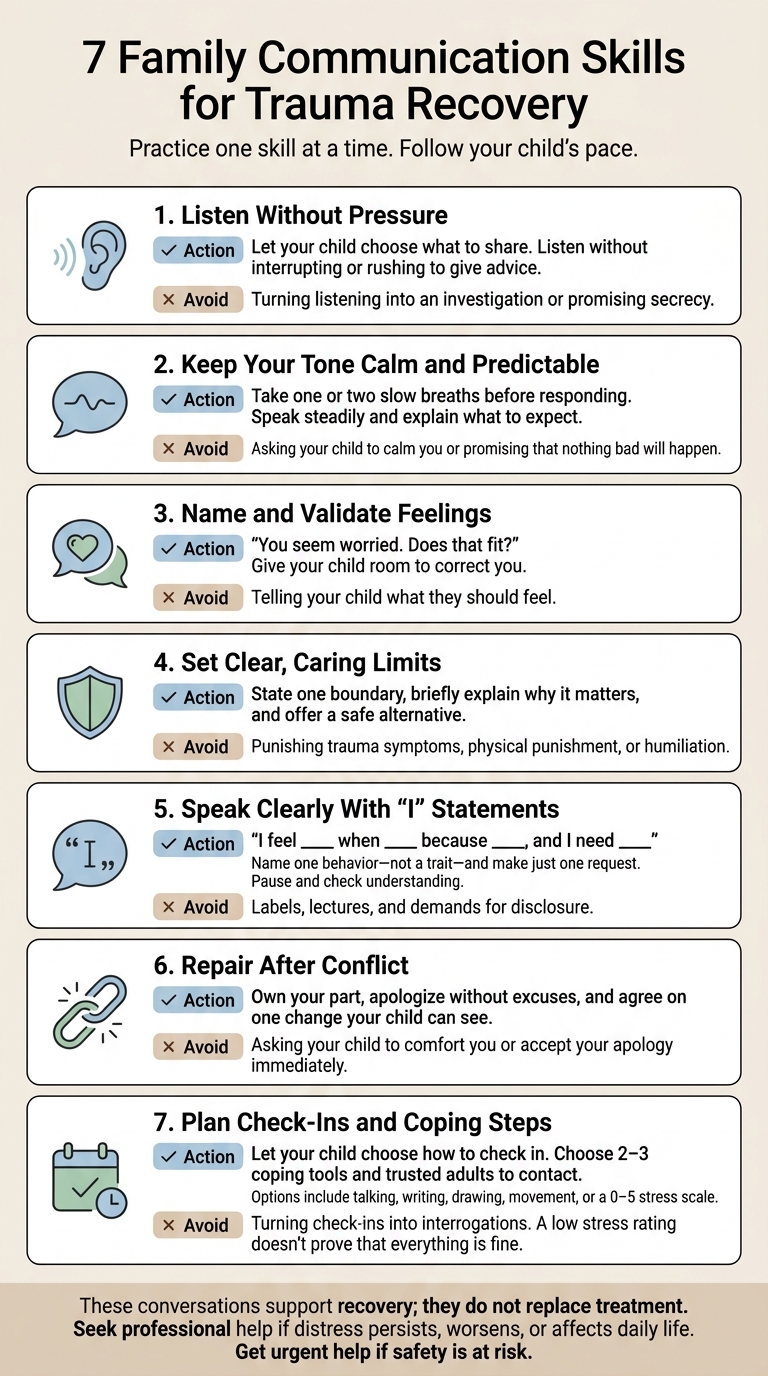
7 Family Communication Skills for Trauma Recovery
How to use Trust-Based Relational Intervention (TBRI) to communicate with kids
Before You Begin: Follow Your Child’s Pace
Let your child decide how much to share. Keep offering low-pressure invitations to talk, allow pauses or subject changes, and come back later. Silence doesn’t mean distress has passed. Steady care helps build safety and trust, making the skills below easier to use.
Use short, concrete words with younger children and respectful, collaborative language with teens. Match your message to your child’s developmental level - not age alone. Check what they understand, and leave out graphic details.
Adjust to your family’s language, culture, beliefs, sensory needs, and disability access needs. Pay attention to whether eye contact or touch feels comfortable for your child. If they’re more comfortable in another language, use a qualified interpreter rather than asking them to translate sensitive information. The goal is safety, voice, choice, and collaboration.
Pause if your child becomes panicked, unusually quiet, or physically distressed. Try a familiar activity or spend quiet time together. Pausing is a communication skill, not a failure. Focus on safety and day-to-day coping, and leave trauma processing to a licensed, trauma-trained clinician. Seek help if distress disrupts sleep, school, or relationships. The seven skills below build on this sense of safety to support everyday communication.
Each skill includes one parent action, child and teen examples, and a mistake to avoid. Use them to choose a response - not to turn every conversation into a lesson.
1. Listen Without Pressure
Purpose in Trauma Recovery
Listening without pressure helps your child feel safe enough to talk. After trauma, children and teens may struggle to organize their thoughts or describe what happened.
Practical Parent Action
Start with presence, not problem-solving. Listen without interrupting, correcting details, or rushing to give advice. Ask one neutral question at a time to understand what your child means - not to collect details.
Reflect the feelings you hear, while leaving room for your child to correct you. Respond calmly and take disclosures seriously. Give age-appropriate answers in words your child understands. Be clear about what you know, what you don’t know, and what you’ll find out. If you promise to learn more, follow through.
Child and Teen Applications
With younger children, sit at eye level during drawing or play. Follow their words or play.
With teens, leave pauses, respect privacy, and do not demand a full account. Side-by-side activities lower pressure and make hard talks easier to start. Ask what support they want before suggesting solutions.
Common Mistake to Avoid
Don’t turn listening into an investigation. Repeated questions, blame, visible alarm, or demands for a complete timeline can make children less willing to share.
Never promise secrecy. If your child may be unsafe, focus on protection and seek professional or emergency help rather than asking for more details. You can request an appointment with a trauma-informed therapist to support your family's healing. Keep your tone calm as your child shares so the conversation continues to feel safe.
2. Keep Your Tone Calm and Predictable
After listening, respond steadily so your child knows what to expect.
Purpose in Trauma Recovery
After trauma, children often look for signs of danger in your voice, face, and movements. A steady response helps them know what to expect.
Practical Parent Action
Take one or two slow breaths before responding. Lower your voice, relax your shoulders, and move slowly. Explain what adults have already done to keep them safe, but don't promise that nothing bad will happen. A calm tone can help you name feelings without making the conversation more intense.
Child and Teen Applications
For younger children, keep routines steady and warn before transitions so they know what to expect.
For teens, offer choices about when and where to talk, then explain schedule changes and follow through to help conversations feel predictable and safe.
Common Mistake to Avoid
Being calm doesn't mean hiding your feelings or pretending everything is fine. Briefly name your worry, then show the coping step you'll take next. Turn to another adult for support rather than asking your child to calm you or listen to graphic details.
3. Name and Validate Feelings
Purpose in Trauma Recovery
After listening, help your child find words for their feelings. Naming feelings can make overwhelm easier to describe. Validation tells them their feelings are real - not that unsafe behavior is okay.
Practical Parent Action
Point out changes you notice without assuming what caused them. Suggest a feeling gently, and give your child room to correct you.
“You seem worried. Does that fit?”
If they disagree or say they don’t know, accept their answer. Acknowledge the feeling before suggesting solutions, and let them end the conversation when they need to.
Child and Teen Applications
For younger children, offer a feelings chart, drawing, or play materials. Avoid treating every drawing or game as evidence of trauma.
With teens, leave room for mixed emotions or numbness. They do not need to name one “right” feeling right away.
Practice during everyday routines so naming feelings becomes a normal habit rather than a big talk.
Common Mistake to Avoid
Don’t tell children what they should feel or push them to get over it. Validation and limits work together to support safety and trust: feelings are okay; unsafe behavior is not. When feelings lead to unsafe behavior, follow with clear, caring limits.
4. Set Clear, Caring Limits
When feelings lead to unsafe behavior, respond with empathy and a clear limit.
Purpose in Trauma Recovery
Predictable limits help children know what to expect and stay safe. Explain the rules clearly, and give children choices within those limits.
Practical Parent Action
State one boundary, briefly explain why it matters, and offer a safe alternative.
If a child is hitting or throwing things, say the behavior is unsafe and offer a stomping mat or short break.
Agree on the rule and how you’ll respond ahead of time. Keep consequences tied to the behavior.
Child and Teen Applications
For younger children, use one-step directions.
With teens, agree on curfew, check-ins, transportation, and consequences when everyone is calm. Explain that ordinary messages stay private, but safety concerns may require involving trusted adults or professionals. Talk about these exceptions before a crisis.
Common Mistake to Avoid
Don’t punish trauma symptoms. Address unsafe actions first, and wait until the child is calmer to talk. Avoid physical punishment or humiliation. The American Academy of Pediatrics advises against physical punishment.
When limits create tension, the next step is repairing the connection.
5. Speak Clearly With “I” Statements
Purpose in Trauma Recovery
Once things are calmer, use I-statements to share your concern and ask for what you need without blame. The pattern below helps keep your message calm, brief, and specific.
Practical Parent Action
-
State: Use this pattern:
Name one behavior - not a trait - and make just one request. Keep it brief.I feel ___ when ___ because ___, and I need ___ - Pause: Give your child time to process what you said.
- Restate: Ask your child to repeat the plan in their own words. Clarify once if needed.
Child and Teen Applications
With younger children at bedtime, give one expectation and two choices, such as which routine step comes first.
With teens facing a routine change, explain what changed, what stayed the same, and what is still uncertain; invite questions without expecting immediate agreement.
Common Mistake to Avoid
Starting with “I feel” does not erase blame. Avoid labels, lectures, and demands for disclosure. Don’t use your child’s trauma history to win an argument. Keep your message truthful and focused on the current behavior and what you’re asking them to do next.
6. Repair After Conflict
Purpose in Trauma Recovery
Repair helps restore emotional safety and trust after conflict. It shows children that a disagreement doesn’t have to end in disconnection - and that adults can take responsibility for their actions.
Practical Parent Action
After a tense moment, repair promptly and calmly. If you need a break, tell your child when you’ll return, then keep that promise. Acknowledge your part, listen to their experience, validate their feelings, and apologize without excuses. Agree on one change your child can see:
Use a pause signal and a 10-minute return time.
Follow through with the same response next time.
Child and Teen Applications
With younger children, name what happened and apologize in simple words. Offer a calm reconnection step, such as drawing together. Do not force eye contact or affection.
Give teens time and privacy before revisiting the conversation. After a disagreement about curfew, ask what would help next time, without asking for forgiveness.
Use this repair conversation to plan the next check-in.
Common Mistake to Avoid
Don’t turn an apology into an excuse. Blaming your child or asking them to comfort you shifts responsibility away from your behavior. Keep appropriate limits, but own how you enforced them. An apology needs changed behavior - not immediate acceptance - to become meaningful.
7. Plan Check-Ins and Coping Steps
Purpose in Trauma Recovery
After repair, regular check-ins help your family spot stress before it builds. Predictable check-ins make support easier to ask for. Listen, speak calmly, and keep limits clear.
Practical Parent Action
Set aside a few minutes each day after school, before bed, or at another calm time. Let your child choose how to check in: talking, writing, drawing, movement, or a 0–5 stress scale.
During a calm moment, plan for early signs of stress. Choose 2–3 coping tools and trusted adults to contact. Include small changes to routines, and review what helps each week.
For intense reactions, reduce noise, offer space or company, try a familiar coping tool, and contact the designated adult. Get urgent help if safety is at risk.
Child and Teen Applications
With younger children, ask one brief question and let them draw their response. Listen first; offer solutions later.
Let teens choose the time and method. Agree on a private code word for requesting support. Identify another trusted adult, such as a school counselor, and explain that privacy ends when safety is at risk.
Common Mistake to Avoid
Don’t let check-ins turn into interrogations. Avoid repeating questions or asking for traumatic details. A low stress rating doesn’t prove that everything is fine. Let your child decline, keep support available, and focus on what helped - not whether they stayed calm.
If check-ins keep bringing up panic, shutdown, or safety concerns, outside support may be needed.
When to Seek Professional Help
If check-ins repeatedly bring up panic, shutdown, or safety concerns, outside support can help. Seek a mental health evaluation when distress persists, gets worse, or disrupts daily life. Watch for nightmares, changes in appetite or sleep, withdrawal, aggression, trouble concentrating, or declining school performance. Younger children may show separation anxiety or regression. SAMHSA notes that trauma-related behaviors lasting more than about 2–4 weeks may call for added support. Don’t wait that long if symptoms are severe.
Keep notes on your child’s sleep, mood, behavior, physical complaints, and changes at school. Share them with your child’s pediatrician or a licensed clinician who has experience with childhood trauma.
Self-harm or suicidal thoughts need immediate help. In the United States, call or text 988 for free, confidential crisis support 24/7, including when you’re worried about your child. Call 911 for immediate danger, an active suicide attempt, an overdose, a severe injury, or another medical emergency. During acute suicide risk, secure dangerous items if you can do so safely. Don’t promise secrecy, and don’t leave your child alone.
BestLife Counseling offers in-home and outpatient trauma-focused therapy, along with APN support for psychiatric evaluation, medication management, and counseling.
Conclusion: Practice 1 Skill at a Time
Practice these skills in small, everyday moments, focusing on one skill at a time: listening, staying calm, naming feelings, setting limits, using “I” statements, repairing conflict, and keeping check-ins predictable.
Start with one calm moment today, whether at bedtime, after school, or during a meal. Let your child choose the pace and format. Aim for consistency, not perfection.
If you lose patience, repair and reset. Use these skills alongside trauma-focused care when symptoms persist, worsen, disrupt daily life, or affect safety. Practice the skill again at the next calm moment.
FAQs
How can we tell if our communication is helping?
Communication is helping when family members break recurring argument cycles, talk more calmly, and use tools they’ve agreed on, such as timeouts or active listening. You may also notice family members sharing feelings openly rather than withdrawing or shouting.
Another sign is sticking with new communication habits and boundaries, even during everyday stress or changes in family life. Professional guidance from services like BestLife Counseling can help you track these positive changes.
What if caregivers disagree on setting limits?
When caregivers disagree on limits, children can face mixed messages and repeated conflicts. Work together to turn vague expectations into clear rules you all agree on. Set shared goals and consistent consequences so your child knows what to expect from every caregiver.
If you’re still stuck, family therapy with providers like BestLife Counseling can help you spot patterns and build simple, shared plans that consistently support your child’s needs.
How can siblings support recovery without feeling responsible?
Siblings can support a family member’s trauma recovery without taking on a caregiver role. Being there matters, but hiding your own stress or feelings to seem supportive - known as “protective buffering” - can lead to isolation instead of connection. Use “I” statements to share your needs and feelings without blame.
BestLife Counseling’s in-person family therapy helps siblings set healthy boundaries and stay involved in recovery without becoming overwhelmed.